Top 10 Speed Door Manufacturers for Global Buyers

Choosing a speed door is a practical decision, not just a matter of comparing product photographs. A warehouse may need fast access for forklifts, while a food-processing area may require smooth surfaces and frequent cleaning. The right choice depends on the opening size, traffic volume, operating environment, and maintenance plan.

This guide introduces ten speed door manufacturers for global buyers. It considers useful comparison points, including door types, opening speeds, safety features, customization, service support, and the availability of replacement parts. Details matter. A door that performs well in a dry distribution center may not suit a damp production room or an exposed loading bay. Buyers should check specifications against real site conditions, such as daily opening cycles, wind exposure, and clearance around equipment.

Manufacturer information can change, and regional service coverage is not always easy to compare. This overview is a starting point, not a substitute for reviewing current technical documents or requesting a project-specific quotation. Some comparisons will remain imperfect because companies publish different levels of detail. That limitation deserves attention. Before selecting a supplier, confirm installation requirements, safety options, warranty terms, and expected maintenance intervals with its team. Fit comes first. The following list aims to help buyers ask clearer questions and narrow their options with greater confidence.

Top 10 Speed Door Manufacturers for Global Buyers

What Speed Doors Are and How They Work

A speed door is a powered barrier designed for frequent, rapid opening and closing. Its flexible curtain travels vertically or horizontally within side guides, driven by a motor and controlled by a panel. Motion sensors, pull cords, or vehicle detectors trigger opening; photo eyes and safety edges help prevent contact before the curtain closes. Some models reset after accidental impact. That speed matters. In a busy loading bay, a forklift can pass through while the doorway stays open for less time than with a conventional door.

The 2023 Global Status Report for Buildings and Construction from UNEP reports that buildings and construction used 34% of global energy demand and produced 37% of energy- and process-related CO2 emissions in 2022. These are sector-wide figures, not savings attributable to speed doors. Grand View Research valued the wider industrial doors market at USD 7.67 billion in 2023 and projected 5.3% annual growth through 2030. For buyers, the practical choice depends on opening frequency, clear width, washdown needs, and impact risk. Still, fast is not automatically better. Poorly positioned sensors can cause nuisance openings, while an unsuitable curtain may wear quickly in a dusty or windy passage. Check the duty cycle, safety features, and maintenance access against the actual site.

Common Speed Door Types and Their Industrial Applications

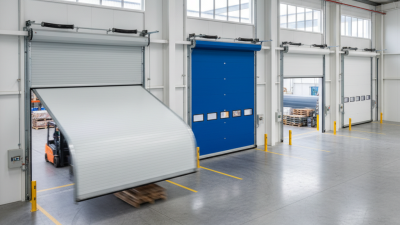
High-speed doors help control traffic, temperature, dust, and drafts in busy facilities. Roll-up fabric doors open vertically and suit warehouses, production lines, and forklift routes. Their flexible curtains can tolerate minor contact, but repeated impacts still require inspection. Folding doors use reinforced panels and often fit wider openings exposed to wind. Speed matters.

Spiral doors use rigid slats and compact tracks, making them useful where insulation and frequent operation both matter. They are common between indoor production zones and loading areas. Freezer-rated high-speed doors can limit warm, humid air entering chilled rooms. In food processing, smooth surfaces and accessible cleaning points are practical features. Still, a fast door is not automatically the right door; traffic volume, opening size, washdown routines, and available headroom all affect the choice.

Tips: Measure clear height and width, then record peak vehicle traffic during a normal shift. Check the door’s safety sensors and emergency operation with a qualified installer. A small site detail can change the selection. I would not choose on opening speed alone.

How to Evaluate Speed Door Manufacturers for Global Buyers

Choosing a speed door manufacturer starts with the opening, not a product brochure. Record clear width, height, traffic volume, and pressure differences between rooms. A warehouse with forklifts needs different impact recovery than a clean production area. Ask for a site survey and written assumptions. Small details matter.

Compare operating speed, cycle rating, curtain material, and safety devices against your actual shifts. Request test records for repeated cycles, wind resistance, and emergency release. Check whether photo eyes, bottom edges, and controls are included or priced separately. A low quote can hide installation work. It happens.

For global projects, evaluate local commissioning, spare-part availability, documentation language, and remote troubleshooting hours. Ask who trains operators and how quickly common components can ship to your destination. Confirm that the design fits building conditions and applicable local requirements; do not rely on a generic certificate alone. Review references from similar climates or industries. Some buyers overlook service, then regret it.

Top 10 Speed Door Manufacturers Serving International Markets

Top 10 Speed Door Manufacturers for Global Buyers

Top 10 Speed Door Manufacturers Serving International Markets

For international buyers, a strong speed door manufacturer offers more than a fast-opening curtain. It should provide clear technical documentation, compatible controls, and practical guidance for local installation teams. Buyers can compare opening speed, cycle ratings, wind resistance, insulation, and safety sensors against the needs of each site. A cold-storage facility and a busy loading bay rarely need the same configuration. Rankings are useful, but criteria matter more.

Manufacturers serving multiple regions should explain how they handle shipping, replacement parts, remote troubleshooting, and commissioning support. Ask whether manuals and wiring diagrams are available in the languages your team needs. Check which components can be sourced locally, and request realistic delivery and service timelines. A polished product sheet cannot guarantee dependable support. That comparison is not always tidy, either; service quality may vary between regions, even for the same supplier.

Tips: Share opening dimensions, daily traffic estimates, temperature ranges, and site photos before requesting a quote. Ask for references from installations with similar conditions, not just impressive showcase projects. Confirm sensor placement and emergency access during the design review. If possible, inspect a working door. Small details, like a curtain’s clearance from nearby equipment, can prevent frustrating changes after installation. Does the proposed service plan fit your operating hours?

How to Compare Suppliers, Certifications, and After-Sales Support

Choosing among the top speed door manufacturers requires more than comparing opening speeds. Request test results for opening and closing cycles, wind resistance, sealing, and safety devices. Ask whether figures come from independent testing or laboratory conditions. Details matter.

Check documentation against the destination market. EN 13241 covers industrial, commercial, and garage doors in Europe; UL 325 addresses operator safety in the United States. ISO 9001 describes a quality-management system, not product certification. Confirm which standards apply to the complete door assembly. After-sales support deserves equal scrutiny: request written response times, local technician coverage, spare-parts availability, and warranty exclusions. The UNEP and GlobalABC 2023 Global Status Report found buildings used 34% of global energy and produced 37% of energy- and process-related CO₂ emissions in 2022. This is not a door-specific figure, but it supports asking for measured air-leakage and opening-cycle data rather than relying on broad energy claims.

Tips: Ask for a sample service report and a parts list. Check whether routine maintenance is included. A low bid can look convincing; unclear response times may change the calculation. Don’t assume. The fine print matters.

Top 10 Speed Door Manufacturers for Global Buyers — How to Compare Suppliers, Certifications, and After-Sales Support Supplier comparison matrix · Use the same criteria and request comparable evidence from every supplier.
No. Comparison dimension What buyers should compare Evidence to request Why it matters
1 Product application Confirm whether the door is designed for internal or external use, cold storage, clean areas, vehicle traffic, or high-wind locations. Product datasheet identifying the intended environment, operating limits, and available configurations. A door selected for the wrong environment may not provide the required performance or service life.
2 Opening speed and duty cycle Compare the stated opening and closing speeds, expected cycles per day, and any duty-cycle limitations for the proposed model. Model-specific technical data and written confirmation of suitability for the buyer’s expected traffic. Actual performance depends on the selected model, size, controls, and site conditions; do not compare headline speeds alone.
3 Safety systems Check the proposed entrapment-protection measures, such as photoelectric devices, safety edges, presence detection, and emergency operation, as applicable. Safety-device list, installation instructions, risk-assessment information, and test or conformity documents for the exact configuration. Safety requirements vary by application and jurisdiction. Verify the complete installed system, not just the door curtain.
4 Applicable standards and regulations Identify the standards and legal requirements relevant to the destination market and the specific door type. Declaration or conformity documentation that identifies the applicable legislation, standards, product model, and responsible entity. CE and UKCA marking relate to applicable market requirements; the relevant obligations depend on product scope and destination. A marking alone is not proof of every requested performance claim.
5 Quality management Ask whether the manufacturing site operates a certified quality-management system and whether its scope covers the relevant activities. Current ISO 9001 certificate, including certificate scope, site address, issuing body, and validity dates. ISO 9001 concerns quality-management systems; it is not a product certification or a guarantee of a particular door’s performance.
6 Configuration and customization Compare available dimensions, curtain materials, vision panels, colors, control options, and site-specific adaptations. Approved drawings, configuration schedule, materials specification, and a list of deviations from the standard product. Clear configuration records help prevent mismatches between the quotation, manufacture, installation, and maintenance requirements.
7 Installation and commissioning Confirm who is responsible for installation, electrical connections, commissioning, operator training, and handover. Installation method statement, commissioning checklist, training plan, and written division of responsibilities. Installation quality and correct commissioning affect safe operation and may be conditions of warranty coverage.
8 Warranty and service terms Compare warranty duration, covered components, exclusions, response commitments, and whether labor or travel is included. Written warranty terms and a service-level agreement for the destination location. Warranty coverage and service response times are contract-specific; they should not be assumed from general product descriptions.
9 Spare parts and technical support Check the availability of replacement parts, technical documentation, remote troubleshooting, and local or regional service coverage. Parts list, parts availability statement, support contact process, and details of authorized service coverage. Accessible parts and support can reduce downtime, especially where the door is essential to production or temperature control.
10 Quotation and delivery transparency Compare the quoted scope, exclusions, delivery basis, lead-time assumptions, packaging, and responsibilities for transport and import. Itemized quotation, delivery schedule, shipping terms, packing details, and a written list of buyer-supplied items. A like-for-like scope comparison helps reveal cost or schedule differences that may be hidden in headline prices.

Buyer note: This is a supplier-evaluation framework, not a ranked list or verification of individual manufacturers. Request current, model-specific documents and confirm applicable requirements with the relevant market authorities or a qualified compliance professional.