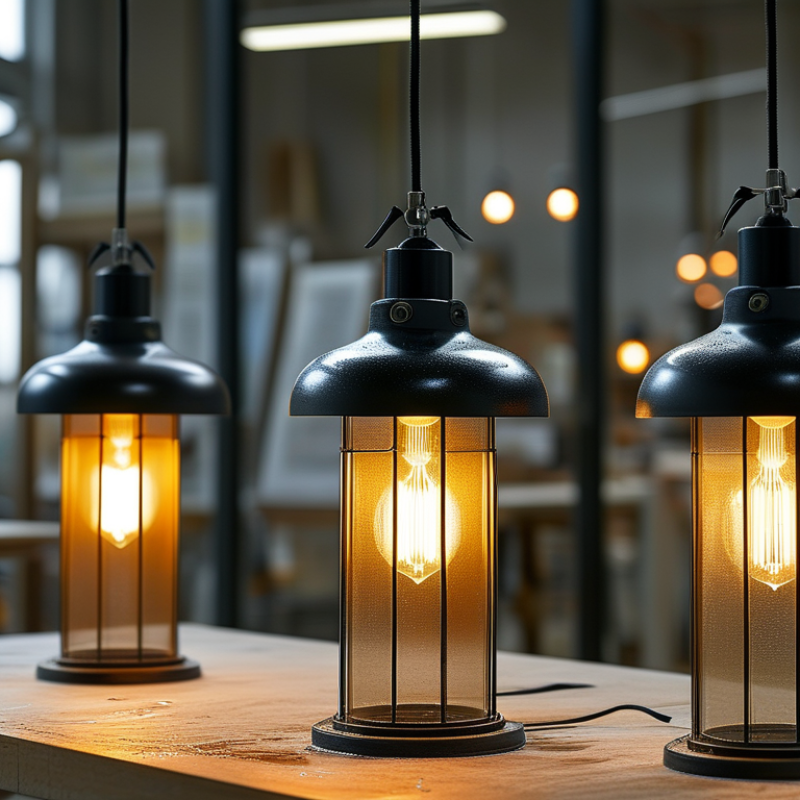
| Housing Material | Powder-coated steel, aluminum, polycarbonate, or a combination of metal and polymer components. | Material selection affects heat dissipation, corrosion resistance, impact resistance, weight, and service life. | Use aluminum for better thermal management; use polycarbonate where low weight and impact resistance are priorities; use treated steel for cost-sensitive indoor projects. | Review the bill of materials, corrosion-treatment process, coating thickness, and material test documentation. |
| Diffuser Material | Opal or frosted polycarbonate, acrylic, or tempered glass. A diffuser should provide uniform light without excessive glare. | The diffuser influences light distribution, yellowing resistance, impact safety, cleaning requirements, and visual comfort. | Polycarbonate is suitable for areas requiring impact resistance; acrylic generally offers good optical clarity; tempered glass is suitable where heat and scratch resistance are important. | Check optical data, impact test results, UV-aging information, and the declared material grade. |
| Corrosion Resistance | For normal indoor use, a durable powder coating is generally adequate. Damp, coastal, or industrial locations require enhanced coating and corrosion protection. | Humidity, salt spray, chemicals, and condensation can damage the housing, fasteners, electrical contacts, and coating. | Specify stainless or corrosion-resistant fasteners and a suitable coating system for coastal, bathroom, parking, and industrial environments. | Request salt-spray or corrosion-test results where the project environment requires them. Do not treat a salt-spray duration as a universal service-life guarantee. |
| Ingress Protection | IP20 Dry indoor areas
IP44 Areas exposed to splashing
IP54–IP65 Dusty, damp, or semi-outdoor areas | The IP code indicates protection against solid objects and water ingress under defined test conditions. | Select the rating according to the actual installation environment, not only the product appearance. IP ratings do not measure corrosion resistance or impact strength. | IEC 60529 or the applicable national adoption. Verify that the rating applies to the complete installed luminaire. |
| Impact Protection | IK06 Moderate impact resistance
IK08–IK10 Higher protection for public, industrial, or vandal-prone areas | IK classification indicates resistance to mechanical impact and helps reduce damage from accidental knocks or vandalism. | Consider higher IK levels for schools, sports facilities, corridors, warehouses, transport areas, and low-mounted luminaires. | IEC 62262 or the applicable national adoption. Confirm that the test covers the diffuser and other exposed components. |
| Electrical Protection Class | Class I Protective earth required
Class II Double or reinforced insulation
Class III Safety extra-low voltage supply | The protection class defines how the luminaire protects users against electric shock. | Match the luminaire class with the building wiring system and local electrical code. Class I products require a reliable protective-earth connection. | Check the product marking, wiring diagram, installation instructions, and safety test report. |
| Operating Voltage and Frequency | For global projects, a common driver range is 100–277 V AC, 50/60 Hz, where permitted by the design and local regulations. | Correct voltage compatibility reduces installation failures, flicker, overheating, and premature driver damage. | Confirm the actual supply voltage before purchase. A wide-input driver does not automatically guarantee compliance in every country. | Review the driver label, datasheet, surge test information, and local electrical requirements. |
| Surge Protection | Indoor commercial projects commonly specify at least 1–2 kV differential-mode and 2–4 kV common-mode protection; higher levels may be required outdoors or in unstable grids. | Surge protection helps protect the driver and LED system from switching events and transient overvoltage. | Use a higher rating for large buildings, industrial sites, outdoor-adjacent locations, and regions with frequent electrical disturbances. | Check the test method, surge waveform, protection mode, and whether the rating applies to the complete luminaire or only the driver. |
| System Efficacy | For 2026 purchasing targets, approximately 100–150 lm/W is a practical range for many efficient surface-mounted LED luminaires, depending on optics, power, and control features. | System efficacy measures delivered lumens per watt and is more useful than LED-chip efficacy alone. | Compare products at the same color temperature, beam distribution, ambient temperature, and delivered-light condition. | Use LM-79, EN 13032, CIE, or equivalent photometric test data. Confirm whether the value includes the driver and diffuser. |
| Power Consumption | Typical surface-mounted LED products range from approximately 10 W to 60 W, depending on size, lumen output, and application. | Lower wattage does not necessarily mean lower energy use if the luminaire delivers insufficient light or requires more units. | Select based on required maintained illuminance, spacing, mounting height, and lighting design rather than wattage alone. | Review rated input power and compare it with the photometric file and lighting calculation. |
| Lumen Maintenance | Prefer a declared life such as L80 at 50,000 hours or longer, with the ambient temperature and failure criterion clearly stated. | Lumen-maintenance data indicates how much light remains after the stated operating period; it is not the same as guaranteed failure-free life. | Use more conservative ratings for continuously operated commercial, healthcare, industrial, and high-ceiling installations. | Check LM-80 data for LED packages and TM-21 projections, plus complete-luminaire test data where available. |
| Color Temperature | 2700–3000 K Warm appearance
3500–4000 K Neutral appearance
5000–6500 K Cool or daylight appearance | Color temperature affects visual atmosphere, perceived brightness, comfort, and consistency across a project. | Warm CCTs suit hospitality and residential spaces; 3500–4000 K is widely used in offices and retail; higher CCTs should be selected carefully to avoid excessive visual harshness. | Check the nominal CCT, tolerance category, and consistency between batches. |
| Color Rendering | CRI/Ra ≥80 for general commercial use; CRI/Ra ≥90 for retail, hospitality, healthcare, art, and color-critical areas. | Higher color rendering helps objects, finishes, skin tones, and products appear more natural. | For product display, also review R9 or other relevant color-quality metrics rather than relying on Ra alone. | Review the photometric report and the declared test standard. Avoid comparing CRI values measured using different methods without checking the details. |
| Flicker and Stroboscopic Effects | Prefer low-flicker drivers with documented flicker percentage and flicker index across the operating range. | Excessive temporal light modulation can cause discomfort and may create visible stroboscopic effects with moving machinery or rotating equipment. | Give special attention to offices, video recording areas, workshops, factories, sports spaces, and environments with rotating machinery. | Request data measured according to applicable IEEE 1789, IEC TR 61547-1, or local requirements. Check performance at dimmed and full output. |
| Power Factor and THD | For commercial products, target power factor ≥0.90 at rated load and total harmonic distortion preferably below 20%, subject to local requirements. | Power factor affects electrical loading, while harmonic distortion can influence power quality and system design. | Higher-performing drivers are beneficial in large installations with many luminaires or limited electrical capacity. | Check driver test data at the stated input voltage and load. Do not assume the value remains constant when dimmed. |
| Dimming and Controls | Specify non-dimming, 0–10 V, DALI-2, phase-cut, sensor-compatible, or other control interfaces according to the project. | Controls can reduce energy consumption and support occupancy, daylight, scheduling, and smart-building functions. | Confirm compatibility among the luminaire, driver, sensors, control system, emergency system, and local wiring practice. | Review the control protocol, dimming curve, minimum dimming level, standby power, and compatibility list. |
| Photobiological Safety | Prefer a documented risk assessment for the complete luminaire. General indoor luminaires are commonly designed to meet low-risk requirements under normal use. | Photobiological evaluation considers optical radiation risks to the eyes and skin, particularly for high-output or specialized products. | Request additional assessment for high-intensity, narrow-beam, adjustable, ultraviolet, or specialty lighting systems. | IEC 62471 and applicable national or regional requirements. The assessment should cover the complete luminaire configuration. |
| Safety and Performance Standards | Common references include IEC 60598-1 for general luminaire safety, IEC 60598-2-1 for fixed general-purpose luminaires, and IEC 61347 for controlgear. | Standards address construction, electrical safety, thermal performance, insulation, marking, and testing. | Use the standard applicable to the destination market and luminaire construction. National deviations may apply. | Request a current test report or certificate from a competent testing body and confirm the report model matches the supplied product. |
| Market Access and EMC | Depending on the destination, requirements may include CE marking, UKCA marking, FCC requirements, or other national conformity schemes. | Market-access rules cover safety, electromagnetic compatibility, documentation, labeling, and sometimes energy performance or hazardous substances. | CE and UKCA are conformity markings, not universal proof of independent third-party certification. Confirm the responsible economic operator and technical file obligations where applicable. | Check the destination market's current regulations, EMC test report, declaration of conformity, labeling, and user instructions. |
| Hazardous Substance Compliance | For many international projects, specify compliance with applicable restrictions such as EU RoHS requirements and destination-market chemical regulations. | Restricted-substance compliance supports legal market access and reduces environmental and occupational risks. | Ask for a material declaration covering LEDs, drivers, solder, cables, coatings, and plastics. | Review the declaration, supplier material records, and any required laboratory test results. Requirements differ by jurisdiction. |
| Emergency Lighting Compatibility | If emergency operation is required, specify an approved emergency driver, battery system, duration, indicator, and testing method. | Standard mains-powered luminaires cannot automatically be treated as emergency luminaires. | Define emergency duration, maintained or non-maintained operation, self-test requirements, and local emergency-lighting rules before ordering. | Check the applicable emergency-lighting standard, product certification, wiring diagram, battery specifications, and test records. |
| Thermal Management | Require a declared ambient operating range, commonly around -20°C to +40°C for general products, unless a different range is documented. | LED temperature affects lumen maintenance, color stability, driver reliability, and product life. | Use products with adequate heat sinking and verified performance for hot ceilings, enclosed spaces, cold warehouses, or high-duty-cycle operation. | Review temperature test data, rated ambient temperature, thermal design, and any restrictions on insulation or enclosure installation. |
| Installation and Maintenance | Look for secure mounting hardware, clear wiring terminals, accessible driver replacement, installation instructions, and spare-part availability. | Good serviceability reduces labor cost, downtime, and the risk of unsafe installation. | Confirm ceiling type, mounting method, cable entry, weight, clearance, and compatibility with junction boxes before purchase. | Inspect installation drawings, torque requirements, maintenance instructions, and replacement-component specifications. |
| Documentation Package | Require datasheet, IES or LDT photometric file, installation manual, declaration of conformity, safety report, EMC report, and warranty terms. | Complete documentation supports design approval, customs clearance, site inspection, maintenance, and future replacement. | Ensure all documents identify the exact model, revision, electrical configuration, CCT, driver, and optical option being purchased. | Use a pre-shipment document checklist and retain the approved revision with the procurement records. |