
- High-Performance Doors
-
- Applications
-
-
-
- Clean Room
Stainless steel or composite materials help maintain clean rooms.
-
-
- Coolers
Quick opening speeds & tight seals for temperature control.
-
-
- Parking
Improve security & traffic flow and enhance architectural style.
-
-
- Hurricane Zone
Withstand winds up to 175 mph and comply with the Florida Building Code.
-
-
-
-
- USDA / FDA / cGMP
Increase productivity & address stringent USDA, FDA & cGMP requirements.
-
-
- Freezers
High-speed & perimeter seals minimize the air exchange between areas.
-
-
- Security
High speed & durability ensure secure access.
-
-
- Ventilation
Perforated or screen door panels allow improved air circulation.
-
-
-
-
- Fire Station Emergency Response
When time is of the essence, high speed and reliability are crucial.
-
-
- Warehousing
Fast cycle times and secure seals keep environments separated.
-
-
- Loading Dock
Rugged design & secure seal for oversized openings.
-
-
- Large Openings
Break-away functionality with rugged design seals oversized openings.
-
-
-
-
- Heavy Equipment
Withstands challenges of heavy equipment and fleet truck/car wash environments.
-
-
- Self-Storage
Fast opening speeds and reliable, durable construction keep facilities secure and protected.
-
-
- Industries
-
-
-
- Automotive Dealerships
Reduce energy costs, increase productivity and comfort and enhance customer perception.
-
-
- Cold Storage & Processing
Increase productivity and operational efficiency while reducing energy and maintenance costs.
-
-
- Parking
We offer solutions for Apartment / Condo & Loft, Standalone Parking Facilities and Office Buildings
-
-
-
-
- Food & Beverage
Doors specifically engineered for USDA/FDA and cGMP environments, and assured compliance for uncompromising performance.
-
-
- Mfg/Dist/Warehousing
A complete product line allows facilities to increase efficiency and safety and reduce maintenance and energy costs.
-
-
- Government
Ensure effective security and environmental controls are maintained for critical government operations.
-
-
-
-
- Transit
Keep operations running smoothly and efficient while reducing energy and maintenance costs.
-
-
- Pharma, Nutraceutical & Biotech
Doors that offer quick, secure access, environmental control and reliability for life science facilities.
-
-
- Support Resources
- Parts
- Contact Us
- Blog/News
- Why Rytec
- Sales Rep Locator
- Careers
- Dealers
- Architectural Resources


























2026 Best Types of Mattress Display Racks for Retail?
In 2026, mattress retailers have more display options than a simple floor platform. A suitable Mattress Display Rack can improve product visibility, protect valuable floor space, and help shoppers compare sizes. The best choice depends on the showroom, not a passing design trend. That matters.
This guide introduces common types, including vertical racks, horizontal platforms, tiered displays, wall-mounted systems, and mobile units. Each serves a different purpose. Vertical racks can present several mattresses in a compact footprint, while platforms let customers view and assess a bed at a familiar height. Tiered designs may help organize models by size or price, though they need careful planning to keep labels visible. Mobile racks offer flexibility, but only where the floor layout and product weight allow easy movement. Space is finite.
Before choosing, measure aisles, ceiling clearance, and the actual mattress dimensions. Check the rack’s stated load capacity and how staff will place or remove each mattress. These details are easy to overlook in a catalog photo. A polished display can still feel cramped, or make comparison awkward. Not every store needs the most elaborate system. This overview will help retailers weigh appearance, access, capacity, and adaptability, then match a rack style to real merchandising needs. Small layout tests can reveal problems early; still, no guide replaces checking the specific product’s dimensions and instructions.
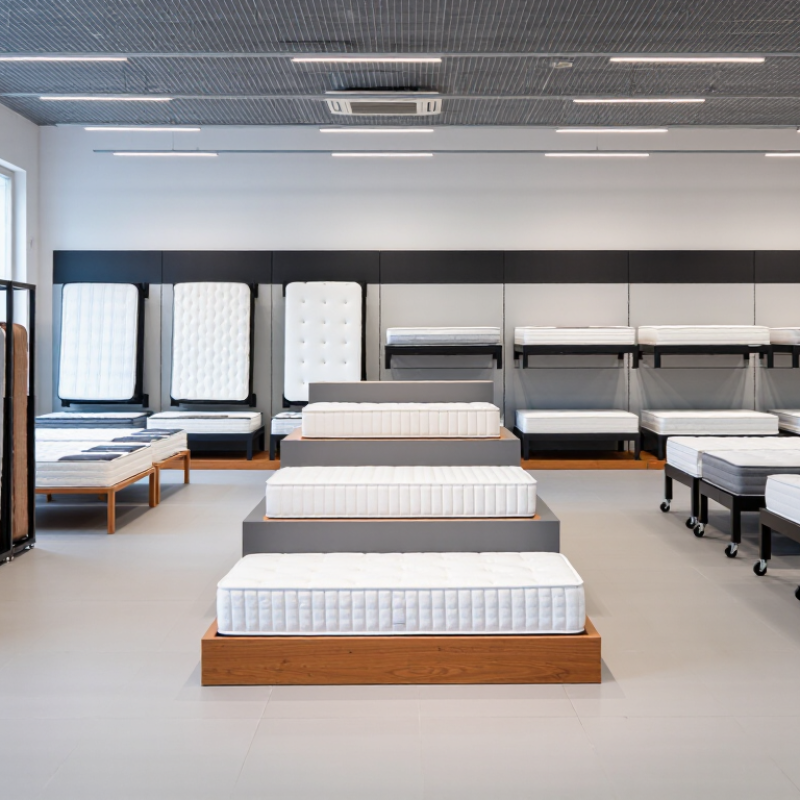
Table of Contents [Hide]
What Mattress Display Racks Do in a Retail Store
In a mattress store, display racks do more than hold products. They lift mattresses to a comfortable viewing height and keep floor samples neatly arranged. A sturdy platform or low-profile frame can make it easier for shoppers to inspect stitching, edge support, and fabric. Some racks tilt slightly, helping customers see the mattress surface without bending far. Others keep several sizes in a compact row. Clear spacing matters. Shoppers need room to walk around a sample and compare its feel without bumping into nearby displays.
The right setup also helps staff explain differences. A rack with an open side can reveal the mattress layers, while a stable base keeps samples from shifting during demonstrations. Small details count: rounded corners, visible size labels, and enough clearance for bedding changes. In busy stores, simple layouts are often easier to maintain than elaborate ones. Still, a rack that looks tidy may not suit every mattress size or floor plan. Measure both before choosing. And check it in use. A display can seem practical on paper, yet feel cramped once shoppers gather around it.